An OEM can purchase the correct tapered roller bearing model and still leave the assembly requirement incomplete. The missing instruction is often the bearing setting: the intended endplay or preload under defined conditions. For procurement teams, the challenge is to connect the component quotation with the equipment drawing, assembly method and acceptance record. This guide explains the terminology and provides a practical specification framework. It is not a universal adjustment procedure or a source of preload values for Mainland products; the equipment designer must approve the actual setting.
Key takeaways
- A bearing designation identifies a component; it does not establish the setting of the installed assembly.
- Specify whether the approved requirement describes cold assembly conditions or operating conditions.
- Fastener tightening torque, bearing rotational resistance and measured endplay are different quantities.
- Approve the measurement method, configuration and change-control responsibilities before comparing production quotations.
1. Define preload and endplay before requesting a price
Timken distinguishes endplay, preload and the transition between them. Endplay allows measurable axial movement under an appropriate checking force; preload involves an intentional interference condition within the mounted arrangement. A zero movement reading alone does not establish the amount of preload. These terms describe the assembled system, not the appearance of an unpacked bearing.
Translate the requirement into a controlled purchasing question: which drawing revision defines the setting, in what condition is it checked, and who approves deviations? If the drawing only says adjust correctly, flag the missing information before issuing a production order. A supplier cannot reliably quote an acceptance requirement that has not been defined.
Avoid confusing setting with the size code, accuracy class or a ball-bearing clearance suffix. Writing C3 beside a generic tapered roller designation does not define the mounted axial setting of an opposed arrangement. Ask the supplier to identify the offered execution and ask engineering to state the installation requirement separately. Familiar terminology should never substitute for the approved specification.
2. Start with the complete bearing arrangement
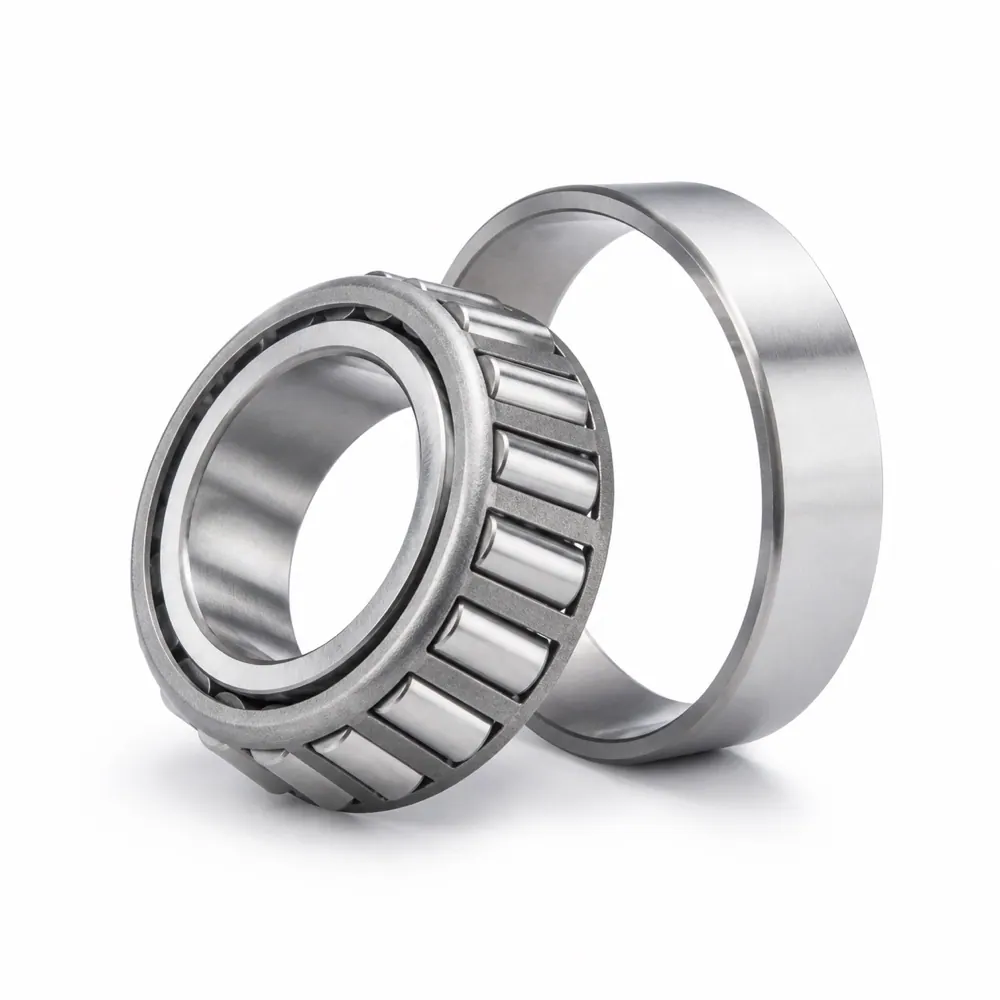
NSK describes single-row tapered roller bearings as separable cone assemblies and cups that commonly work in opposed arrangements. The relationship between the bearing positions matters. Identify the complete pair, its orientation and associated locating components rather than treating each carton as an independent installation instruction.
Attach a section drawing that shows the shaft, housing, shoulders, spacers, covers and locking features. Mark the bearing positions and give the drawing a revision identifier. Include both cup and cone designations when they differ, and identify whether the offer covers complete sets or individual components. A photographed marking is useful evidence, but it does not replace an assembly drawing.
For replacement sourcing, record what was actually found during disassembly and what remains uncertain. Keep measured dimensions separate from assumptions about original adjustment. An old spacer or previously tightened nut may reflect wear, a repair or an undocumented change. Do not promote the condition of a used assembly into a new production requirement without engineering review.
3. Keep cold assembly and operating conditions separate
Timken distinguishes the setting established at assembly from the setting during operation, when thermal changes and deflection can affect the arrangement. This distinction is why a universal cold clearance is not provided here. The drawing must connect the checking condition to the intended service condition rather than assuming that both are identical.
Create two entries in the project record: assembly acceptance and operating acceptance. For assembly, state the required temperature condition and approved measurement procedure. For operation, state the duty cycle, warm-up condition and criteria engineering will evaluate. If a supplier suggests a different cold setting, request the assumptions behind that proposal and the approval route for evaluating it.
Describe startup, continuous operation, reversing duty and shutdown where relevant. Include any available shaft and housing temperature evidence, distinguishing measurements from estimates. The buyer need not calculate thermal behavior, but should make sure that the calculation owner receives the operating information. Missing temperature information is an unresolved engineering item, not permission to choose a convenient adjustment.
4. Specify the performance reason, not maximum tightness
NSK explains preload as elastic loading that can improve rigidity and shaft positioning in suitable arrangements. Too much preload can increase friction and heating; inadequate preload can fail to provide the intended rigidity. The useful question is what the equipment needs, not whether the tightest assembly sounds like the highest quality option.
Ask engineering to describe the functional requirement in measurable terms. It might involve shaft positioning, runout, gear contact or behavior under a specified load. Keep those equipment-level criteria distinct from incoming bearing inspection. A dimensional certificate for an individual component cannot, by itself, demonstrate the behavior of the finished gearbox or hub.
Do not write zero clearance unless engineering has defined the term and checking method. Likewise, do not ask a supplier to guarantee no heat generation or unlimited life. Such phrases are neither useful acceptance limits nor complete technical instructions. Resolve the required setting and associated operating criteria in a drawing or approved specification before discussing a production guarantee.
5. Identify the adjustment hardware and its ownership
NSK identifies position-preload approaches involving adjusted paired components, spacers, shims or axial adjustment hardware. These approaches are not interchangeable purchasing descriptions. The assembly drawing should identify which method is used and which dimensions or characteristics must be controlled for that method.
Separate the scope into supplied bearings, supplied locating parts and customer-owned assembly work. State who manufactures each spacer or shim, who selects its approved dimension, and who controls the locking feature. If the bearing supplier does not supply the spacer, record that boundary explicitly. Otherwise, an assembly problem can become a dispute about an item that was never included in the quotation.
Where preset or matched assemblies are proposed, request the manufacturer's definition, identification rules and installation instructions. Do not assume that a matched spacer is freely interchangeable. Timken distinguishes custom-matched and intentionally interchangeable assembly designs. For the purchasing record, document the specific offered scope rather than describing every paired shipment as a factory-set assembly.
6. Separate fastener torque from bearing measurement
A locknut tightening torque, a bearing rotational-resistance reading and an axial displacement reading are different measurements. Give each a separate field with its own units, instrument and acceptance condition. A torque wrench used on an adjusting nut does not directly report axial endplay, and a free-spinning demonstration does not supply a numerical setting record.
If an approved procedure uses rotational resistance to assess an assembly, specify whether it measures starting or running resistance, which components are included and the lubricant condition. Ask whether seals or other connected parts remain installed during the measurement. Comparing readings taken under different conditions can create an apparent disagreement even when both operators followed their own local instructions.
Do not copy a tightening value, backing-off angle or rotational-torque limit from an unrelated machine. These instructions belong to a defined assembly and procedure. A model such as 30210 is not enough information to authorize one. For vehicle wheel ends and other safety-critical equipment, use the applicable equipment instructions and approved engineering process rather than adapting this general purchasing guide into a workshop procedure.
7. Make the measurement record reproducible
The receiving or assembly record should let a second qualified person understand how the result was obtained. Identify the instrument, checking location, reference surface, loading condition, fixture and measurement sequence required by the approved procedure. Record the units and instrument status. State who can change the method and how a revised method is approved.
Define when the result is recorded: before or after locking, with or without specified connected components, and at the agreed temperature condition. Where the procedure requires repeated readings or positioning operations, document their sequence instead of relying on operator memory. A pass label without the underlying condition is weak evidence when a later production batch behaves differently.
Keep the measuring process within its approved capability. A finer display resolution does not automatically create a more accurate assembly check. Ask the quality owner to evaluate whether the method can distinguish acceptable and unacceptable assemblies against the agreed limits. If the limit is smaller than the reliable measurement capability, escalate the method rather than accepting extra decimal places on a report.
- Approved procedure number, revision and responsible technical owner.
- Instrument identification, units, checking location and fixture condition.
- Assembly state, temperature condition, lubricant and included components.
- Actual results, acceptance decision and any required recheck after locking.
8. Protect assembly quality before judging the setting
NSK's handling instructions emphasize cleanliness, appropriate mounting tools and avoiding the transmission of mounting forces through rolling elements. Follow the approved mounting instructions for the supplied execution. Damage or an incorrect seating condition should not be treated as a setting problem that can simply be corrected by further tightening.
Make component handling part of the sample plan. Specify identification, packaging opening, storage and segregation of questionable parts. Keep bearing sets, locating components and records associated with the correct assembly. If a sample is damaged during examination, mark its disposition so that it cannot quietly return to the production approval group.
For a disagreement, separate observations from conclusions. Record what was seen, the assembly state and the checking method before assigning a cause. A supplier, assembler and equipment designer may each own a different part of the investigation. A joint evidence list usually provides a better starting point than a broad statement that the bearing is too loose or too tight.
9. Approve a sample against a written test plan
NSK's handling guidance includes test operation and attention to abnormal noise, rotation and temperature behavior. These observations belong in a controlled evaluation. They do not provide a universal temperature-rise allowance for every Mainland bearing or prove that a particular setting is correct merely because an assembly initially feels smooth.
Before the sample arrives, write the conditions under which it will be evaluated. Identify the equipment or representative fixture, lubricant, load and speed profile, stabilization condition, recorded observations and stop criteria. Engineering should approve the limits. Procurement should confirm who supplies the evidence, who reviews it and whether a successful sample authorizes production or only the next evaluation stage.
Retain the actual sample configuration and acceptance record. If approval includes a particular spacer, lubricant or assembly instruction, reference those items explicitly. A later shipment that carries the same base bearing model may still differ in an approved detail. The sample is useful as a reference only when its identity and the reason for its acceptance can be traced.
10. Compare quotations and control subsequent changes
Send every candidate supplier the same technical package and ask for a line-by-line scope response. Separate confirmed items, proposed alternatives, exclusions and information still required. Compare the cost of the offered scope, not only the unit bearing price. A quotation that excludes locating parts or assembly verification is not equivalent to one that includes them.
For recurring orders, identify the approved drawing and configuration on the purchase order. State how proposed changes to components, lubricant, marking, packing or supplied documentation will be reviewed. Define how stock affected by a pending change is identified. This makes future sourcing comparisons more reliable without implying that every substitution requires the same approval effort.
When purchasing through a distributor, carry the engineering requirement forward to the downstream order. Keep the manufacturer's technical definition separate from the distributor's stock description. Ask for the exact supplied execution and supporting documents. If an interchange is proposed, dimensional compatibility is only one part of the review; the assembly setting and approved operating requirements must still be addressed.
11. Build a setting-aware RFQ for Mainland Bearings
Use Mainland's model pages to establish the initial component baseline, then send the complete requirement to Oliver Peng. Identify the model, cup and cone scope, quantity, application, destination and drawing revision. Explain whether you are requesting standard components, an interchange review or a documented proposal for a broader supply package. Available options and documentation must be confirmed on the quotation.
A practical request can read: Please quote complete 30210 bearing sets for the attached assembly drawing. The equipment designer will approve the mounted setting and acceptance method. Identify the proposed execution, material scope, included documentation and any assumptions about associated parts. Confirm sample availability, packing, MOQ and lead time for our required quantity and destination. This is an illustrative RFQ, not an installation instruction or a commitment about current inventory.
Leave unresolved technical fields marked pending rather than filling them with another brand's catalogue figures. This guide does not release Mainland preload values, load ratings, speed limits, weights or test results. The objective is a comparable offer and a clear path to engineering approval, so that purchasing, quality and assembly teams work from the same confirmed requirement.
- Complete bearing identification and drawing revision, with unknown markings flagged.
- Arranged bearing positions, associated parts and the proposed supply boundary.
- Approved setting, checking condition and method, or a named owner for unresolved fields.
- Sample evaluation criteria, acceptance authority and required supporting records.
- Order quantity, delivery destination, packing scope and quotation assumptions.
Frequently asked questions
Does a tapered roller bearing model number define its preload?
A base model alone does not define mounted preload. For a preset or matched assembly, obtain the complete designation, supplier-defined setting, associated parts and required mounting conditions. The drawing and approved checking method must still connect that supply scope to the actual equipment arrangement.
Is zero measured endplay proof that the preload is correct?
No. An absence of measurable axial movement does not quantify the preload or confirm that the checking method was suitable. Engineering must define how the intended assembly condition is established and verified. Do not replace that requirement with a subjective tightness check.
Can I use the same adjusting-nut torque for every 30200-series bearing?
No. A fastener torque belongs to a defined assembly and procedure, not an entire size series. Threaded parts, locking features and the measurement condition must be addressed in the approved equipment instructions. Request engineering review if those instructions are missing.
Can a supplied spacer be mixed with a different matched bearing set?
Only if the specific design and manufacturer instructions permit interchangeability. Matched and intentionally interchangeable arrangements are different supply scopes. Preserve the identified component group and obtain written confirmation before mixing parts or approving a replacement.
What should a buyer provide when the setting requirement is unknown?
Send the existing markings, assembly drawing, application, operating duty and any available inspection evidence. Clearly identify missing information and the responsible approval owner. Ask for a documented proposal and sample evaluation plan rather than requesting an arbitrary preload value from the model number alone.
Technical references
This guide uses recognized references as a technical framework. Final requirements must be confirmed for the specific bearing and application.
- Timken: Setting Techniques for Tapered Roller Bearings, definitions and assembly-setting methods ↗
- NSK: Bearing ABCs, Preload, purpose and adjustment concepts ↗
- NSK: Tapered Roller Bearings, separable components and opposed arrangements ↗
- NSK: Handling Instructions for Bearings, mounting precautions and test operation ↗