Buying industrial bearings from China can reduce supply cost, broaden model availability and support private-label programs, but only when the purchasing process is technically controlled. A useful quotation must connect the bearing designation to the real operating conditions, inspection plan, packaging, quantity and delivery requirement. This guide gives OEM procurement teams, industrial distributors and equipment manufacturers a practical method for preparing a buyer-ready RFQ, evaluating a factory, validating samples and protecting repeat-order consistency.
Key takeaways
- Compare suppliers only after the complete model, suffix, application and acceptance criteria are aligned.
- Treat precision class, internal clearance, closures, lubricant and packaging as controlled specifications—not assumptions.
- Verify the factory through process traceability, calibrated inspection records and a measurable sample plan.
- Separate sample MOQ, production MOQ, lead-time stages and Incoterm responsibilities before placing the order.
1. Begin with the application, not the unit price
A bearing is a functional machine component, not a generic piece of hardware. Two products with the same bore, outside diameter and width may differ in internal geometry, heat treatment, radial clearance, cage, seal contact, grease fill and noise performance. These differences influence temperature, torque, service life and installation behavior. A low quotation is therefore useful only after every supplier has confirmed the same technical baseline. Comparing incomplete offers usually moves hidden cost into incoming inspection, field failures, production stoppages or emergency replacement purchases.
Start the sourcing project by describing what the bearing must do. State the machine, mounting position, radial and axial load, rotational speed, duty cycle, ambient and operating temperature, contamination, moisture, vibration and expected maintenance interval. Explain whether failure creates a minor service event or shuts down a production line. A supplier can then check whether a deep groove ball bearing, tapered roller bearing, spherical roller bearing or a customized configuration is appropriate before discussing price. This application-first approach also helps the factory identify questions that a model number alone cannot answer.
2. Write an unambiguous bearing designation
The complete designation is the first control point in an international bearing RFQ. Record the base model and every suffix shown on the ring, box or equipment bill of materials. For a deep groove ball bearing, a code such as 6204-2RS/C3 communicates much more than 6204: it indicates a closure and an internal-clearance requirement in addition to the dimensional series. Supplier suffix systems are not always identical, so write the meaning beside the code. If an interchange is requested, provide the original manufacturer, original designation and whether a functional equivalent is acceptable.
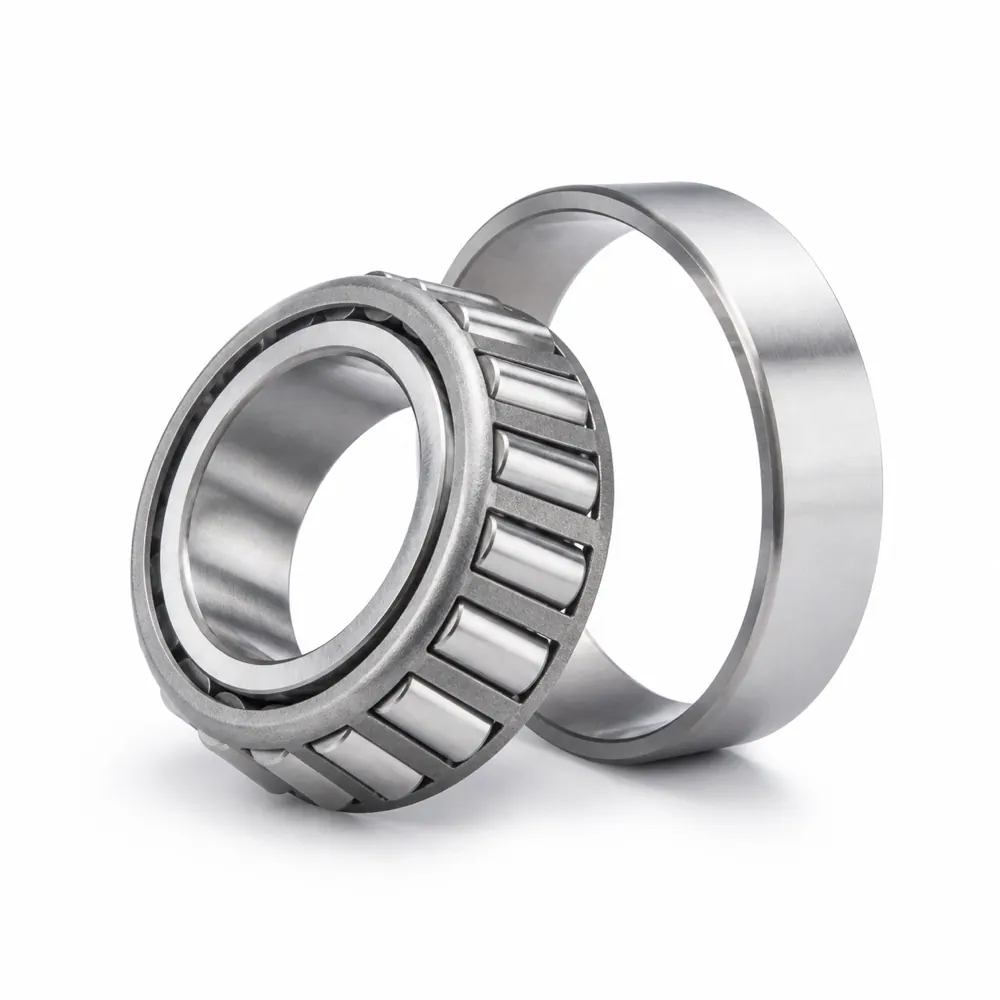
Always state boundary dimensions in millimetres: bore diameter (d), outside diameter (D) and width (B or T). For tapered roller bearings, identify both the cone and cup and confirm whether the quotation is for a complete set or an individual component. For spherical roller bearings, confirm bore type, lubrication groove and hole arrangement, and any adapter or withdrawal sleeve. If the designation is unreadable, attach dimensioned drawings and sharp photographs of all markings. Never ask a factory to infer a critical product from a single blurred image.
- Base model, complete suffix and original brand reference
- Bore, outside diameter, width and relevant chamfer limits
- Required interchange, mating part or mounting drawing
- Complete set versus separate cup, cone, sleeve or accessory
3. Match bearing type to the load system
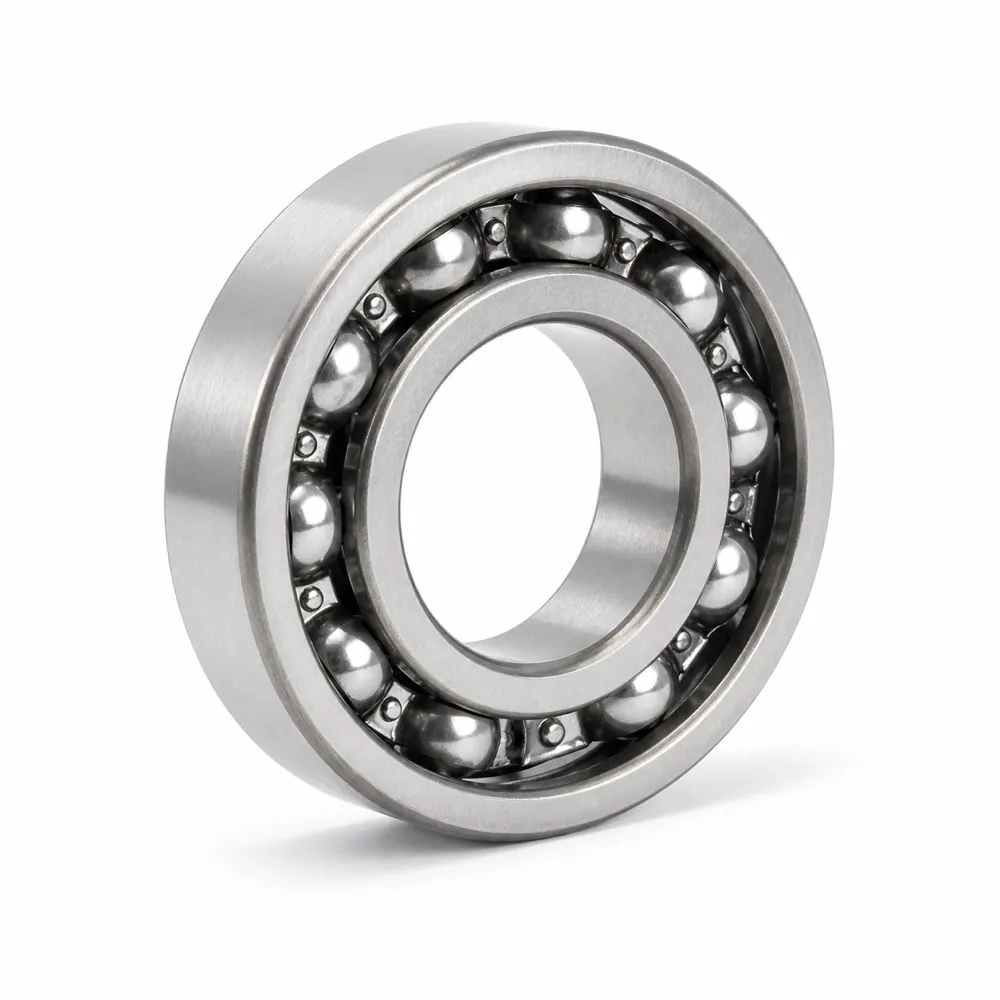
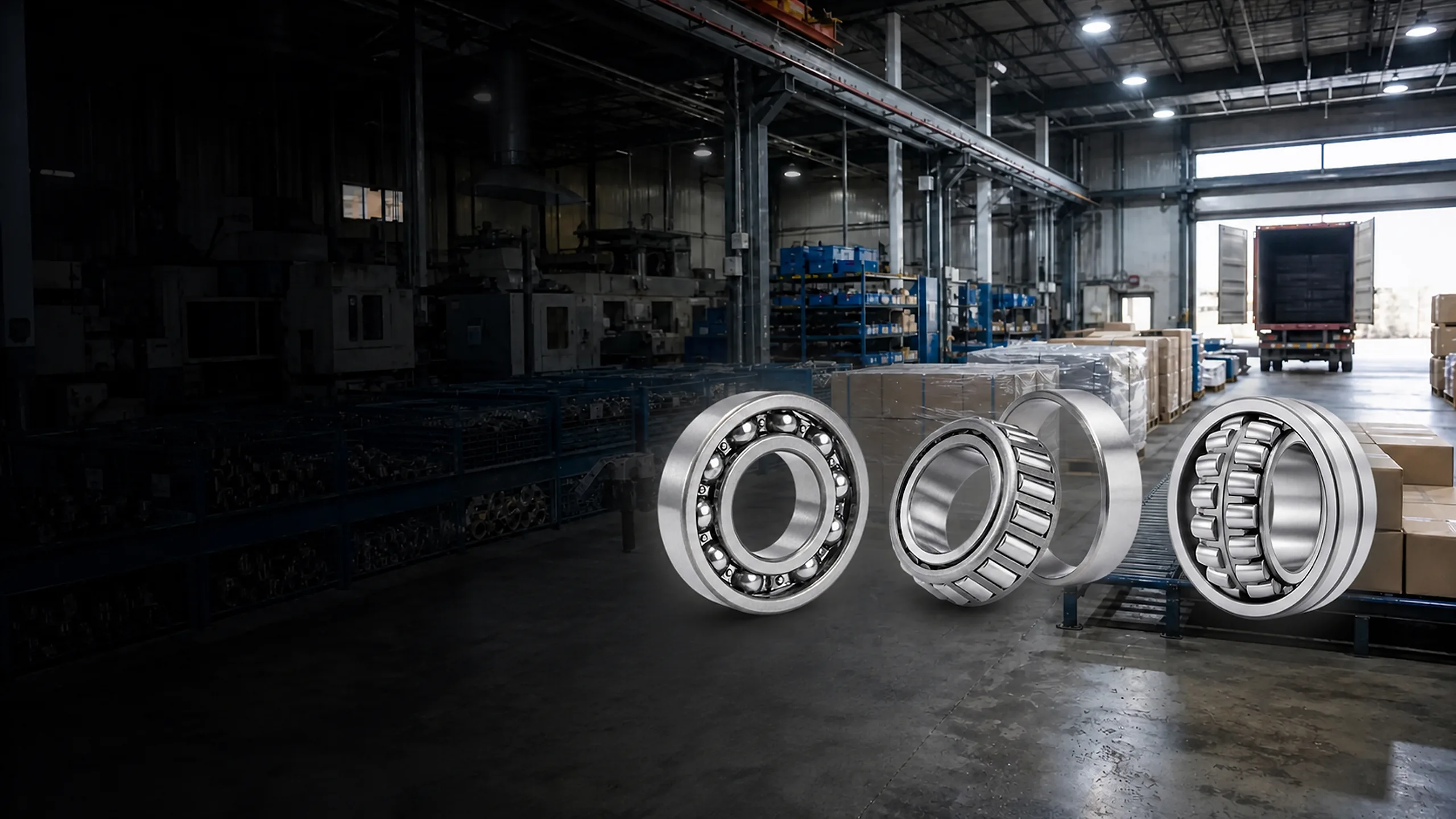
Deep groove ball bearings are widely used where low friction, high speed and mainly radial load are important, with moderate axial load possible in both directions. Tapered roller bearings are designed for combined radial and axial loads and are frequently used in wheel hubs, gearboxes, agricultural equipment and industrial transmissions. Spherical roller bearings provide self-aligning capability and high radial-load capacity for mining, conveying, screening and other equipment where shaft deflection or housing misalignment can occur. Selecting by industry name alone is insufficient; the actual load direction and mounting arrangement remain decisive.
Ask the supplier to confirm the basic dynamic load rating, basic static load rating and limiting or reference speed for the offered design. ISO 281 provides the framework for basic dynamic load rating and rating-life calculations, including modified life considerations such as reliability, lubrication and contamination. Treat a calculated rating life as an engineering comparison, not a warranty of service hours. Wear, corrosion, electrical erosion, installation damage, lubricant loss and unexpected shock loads can dominate real field performance even when the catalogue calculation appears adequate.
4. Define precision, running accuracy and internal clearance
Precision class and internal clearance solve different problems and should never be used interchangeably. Precision class controls dimensional and running tolerances, while internal clearance describes the available movement between the rings and rolling elements before mounting. ISO 492 specifies dimensional and geometrical characteristics and tolerance values for radial rolling bearings. In an RFQ, state the required ISO tolerance class or the accepted equivalent, and list any specific inspection characteristic that matters to the assembly, such as bore deviation, radial runout or width variation.
Internal clearance changes after the bearing is pressed onto a shaft, installed in a housing and heated in operation. Normal clearance may be correct for a general machine, while C3 or another clearance group can be needed for tighter fits, elevated temperature or certain speeds. More clearance is not automatically better: excessive operating clearance can increase noise, vibration and load concentration. Give the supplier shaft and housing fits, temperature difference and speed when clearance is safety- or performance-critical. For paired tapered roller bearings, specify the required endplay or preload and the method used to establish it during assembly.
5. Specify material and heat-treatment evidence
For many standard industrial bearings, high-carbon chromium bearing steel such as GCr15 or SAE 52100 is the normal starting point. The material name alone, however, does not confirm fatigue performance. Steel cleanliness, carbide distribution, forging condition, spheroidizing, hardening, tempering and grinding quality all contribute to raceway integrity. For corrosive environments, food equipment, high temperature or special electrical conditions, stainless steel, coatings, ceramic rolling elements or alternative lubrication may be considered, but the entire system must be evaluated rather than changing one material line on a purchase order.
Request a material certificate or chemical analysis for qualification lots when traceability is required. Define hardness ranges for rings and rolling elements, and ask how the factory controls heat-treatment batches and detects grinding burns or cracks. Do not demand documents that nobody will review. Instead, connect each record to an acceptance decision: material chemistry confirms the ordered grade, hardness confirms the treatment window, and microstructure or crack testing may be added for critical applications. A focused control plan is stronger than a thick, generic certificate pack.
6. Choose seals, shields, cage and lubricant as a system
Open bearings are suitable when the surrounding equipment supplies clean lubricant. Metal shields help retain grease and reduce entry of larger particles while normally creating low running torque. Contact rubber seals improve exclusion of dust and moisture but add friction and may limit speed or temperature. Seal materials and lip designs differ, so the buyer should specify the contaminant, temperature, speed and required protection rather than relying only on 2RS, ZZ or 2Z shorthand. Confirm whether the offered closure is removable and whether seal contact is on one or both sides.
Lubricant selection must match speed, load, temperature, relubrication plan and compatibility with seals and process materials. State the grease brand or performance specification, base-oil viscosity, thickener, temperature range and fill quantity when these items are controlled. Overfilling can raise temperature; underfilling can shorten life. Cage material and construction also affect speed, shock resistance and chemical compatibility. If low noise is important for electric motors, include vibration grade, grease cleanliness and an agreed test method in the sample plan rather than writing only ‘electric motor quality.’
7. Evaluate the manufacturer behind the quotation
A professional website and an ISO 9001 certificate are useful screening signals, but neither proves that a supplier makes the quoted bearing or controls the process. Confirm the legal company name, factory address, export entity and scope shown on each certificate. Ask which operations are in-house: turning, heat treatment, grinding, superfinishing, cage production, assembly, noise testing and packing. If important processes are subcontracted, request the control method and incoming acceptance criteria. The goal is not to reject outsourcing; it is to understand who owns quality at every stage.
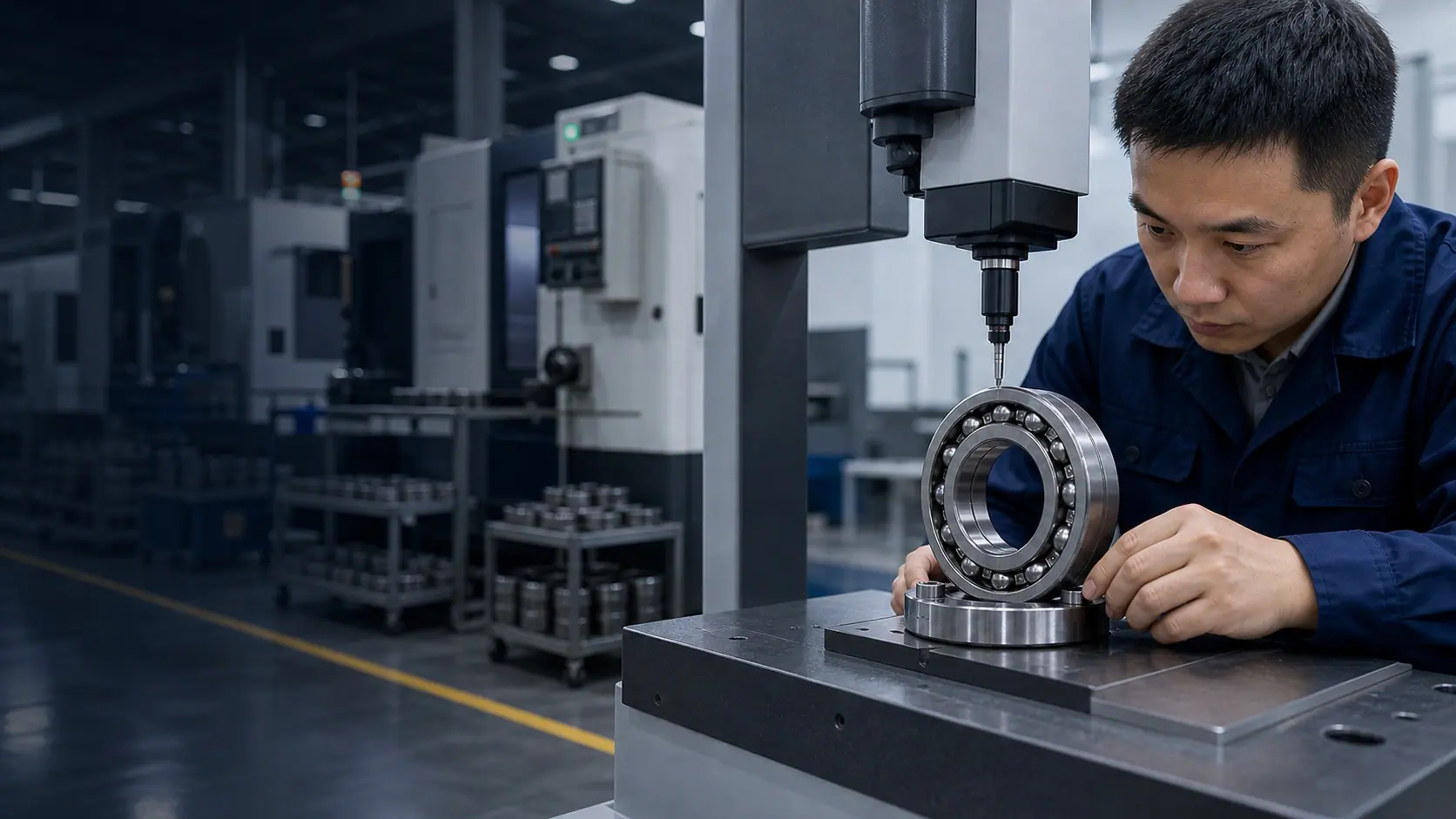
A remote or on-site audit should follow the product flow. Review raw-material identification, batch separation, work instructions, gauge calibration, first-piece approval, in-process checks, nonconforming-product control, final inspection and finished-goods traceability. Look for recorded evidence instead of showroom equipment. Select a recent order and trace it backward from packing label to assembly, grinding, heat treatment and material batch. Then review a rejected lot to see whether corrective action was documented. This simple trace exercise reveals more than a general factory tour.
- Company registration, export entity and certification scope
- In-house processes, approved subcontractors and responsibility
- Calibrated inspection equipment and retained quality records
- Batch traceability from finished carton to raw material
- Nonconformance, corrective action and customer-complaint process
8. Build a measurable inspection plan
Avoid requirements such as ‘premium quality’ or ‘zero defect’ without measurable acceptance rules. Create a control plan that lists the characteristic, specification, measuring method, sample size, frequency, record and reaction plan. Typical bearing checks include visual condition, marking, boundary dimensions, radial clearance, rotation, noise or vibration, hardness, seal fit, grease fill and packaging. Critical dimensions may require a larger sample or 100 percent automatic monitoring, while destructive metallurgical tests are usually performed by batch.
Agree on the sampling standard and acceptance-quality limits before production, including what constitutes critical, major and minor defects. Measurement conditions matter: gauge resolution, reference temperature, fixture, master calibration and operator method can change results. Ask for a sample inspection report using the same fields that will be supplied with mass production. If third-party inspection is planned, give the agency the approved drawing, golden sample, packaging specification and defect classification. Inspecting without an agreed standard only creates arguments after the goods are finished.
9. Validate samples under realistic conditions
A sample order is a controlled engineering stage, not a miniature price order. Begin with document review and dimensional inspection, then check fit, assembly force, rotation and noise on the actual mating parts. Where risk justifies it, run temperature, vibration, speed, load, sealing or endurance tests that represent the real duty cycle. Record the sample lot number and supplier configuration. A sample that passes without traceable records cannot reliably become the production standard.
Freeze the approved specification after validation. Keep a signed golden sample or master data set, including drawings, suffix meanings, material, hardness, clearance, closures, grease, marking, packaging and approved deviations. State that any process, source or design change requires written approval. For the first production order, increase incoming inspection and compare results with the sample report. Gradually reduce inspection only after stable capability is demonstrated across multiple batches. This staged approach protects the launch without turning every repeat order into a complete requalification.
10. Compare MOQ, tooling, price and lead time correctly
MOQ depends on whether the model is standard stock, a scheduled production item or a fully customized bearing. Separate the sample MOQ, production MOQ and annual forecast. Ask whether mixed models can share one shipment and whether private-label cartons, laser marking, special grease or nonstandard clearance create their own minimums. A flexible MOQ is valuable for qualification and spare-parts programs, but repeatedly buying below an efficient production batch can increase cost and lead-time variation.
Request a price breakdown that identifies product configuration, quantity tier, packaging, tooling or artwork, inspection documents and Incoterm. Confirm quotation validity and the exchange-rate assumption if relevant. Lead time should be split into sample preparation, material or component procurement, production, final inspection and delivery to the port or forwarder. Ask whether the quoted number means calendar days or working days and when the clock starts—deposit, drawing approval or packaging approval. For repeat programs, use a rolling forecast and an agreed safety-stock or release schedule instead of relying on emergency air freight.
11. Control marking, packaging and export logistics
Bearing packaging must protect precision surfaces from moisture, impact and contamination throughout the export route. Specify rust-prevention oil or wrapping, individual bag or box, inner-carton quantity, master-carton weight, pallet material, edge protection, stretch film and moisture barrier where necessary. Heavy bearings may require reinforced cases and lifting instructions. Ask for packaging photographs and a packing-list draft before shipment. Ocean transport can expose cargo to humidity and condensation even when the factory floor is dry.
Private-label work should be controlled by approved artwork. Define ring marking, country-of-origin wording, box label, barcode, batch code and carton shipping mark. Confirm the selected Incoterm—such as FOB at a named Chinese port—and identify who books freight, completes export customs, arranges insurance and handles destination charges. Verify the commercial invoice, packing list, certificate of origin and any market-specific compliance documents before dispatch. Clear document responsibility prevents a good product from becoming a delayed or expensive shipment.
12. Use a supplier scorecard for repeat orders
The first order qualifies a product; subsequent orders qualify the supply system. Track on-time delivery, accepted quantity, dimensional and functional defects, document accuracy, packaging damage, response time and corrective-action closure. Weight the scorecard according to business risk. A slightly higher-priced source with stable delivery and fast technical support may deliver a lower total cost than the cheapest quotation. Share performance data with the supplier so improvement priorities are visible and disputes are based on records.
For critical models, consider a dual-source or contingency plan, but ensure both suppliers are qualified to the same controlled specification. Maintain revision control for drawings and purchase specifications, and include the revision on every order. Review certificates, process changes and approved sub-suppliers periodically. When a defect occurs, preserve the bearing, packaging, batch code, installation details and operating history. A structured failure report allows the manufacturer to distinguish material or process defects from fit, lubrication, contamination or mounting problems and to issue a useful corrective action.
13. Copy this industrial bearing RFQ checklist
A concise RFQ should allow a technically competent factory to quote without guessing. Use the checklist below as the first page of your request, then attach drawings, photographs, specifications and packaging artwork. Ask the supplier to list every exception in the quotation. If a field is unknown, mark it ‘supplier to recommend’ and provide the application data needed for that recommendation. This is safer than leaving the field blank.
- Company, buyer, destination country and required quotation date
- Bearing model, full suffix, quantity, annual demand and sample quantity
- Dimensions, bearing type, load, speed, temperature and duty cycle
- Material, hardness, precision class and internal clearance
- Seal or shield, cage, lubricant and noise or vibration requirement
- Inspection characteristics, sampling plan and required reports
- Ring marking, private-label box, carton, pallet and barcode requirements
- Target shipment date, named Incoterm, port and preferred payment terms
- Drawing revision, approved alternatives and change-notification requirement
14. Turn a quotation into a controlled supply program
Successful China bearing sourcing is not based on finding one attractive price. It comes from creating a specification that different suppliers interpret consistently, selecting a factory whose process matches the risk, validating a traceable sample and controlling every repeat order with measurable evidence. This requires more work before the purchase order, but it reduces the much larger cost of line stoppages, warranty claims and rushed replacements.
Mainland Bearing supports industrial distributors, OEMs and equipment manufacturers with deep groove ball bearings, tapered roller bearings, spherical roller bearings and OEM/ODM configurations. To receive a comparable factory quotation, send the complete model or drawing, annual quantity, application, required precision and clearance, closure and lubrication, inspection documents, packaging and destination. Our team will identify missing technical items before confirming MOQ, sample plan, production lead time and FOB China terms.
Frequently asked questions
What information should a bearing RFQ include?
Include the complete model and suffix, dimensions, quantity, annual forecast, application, load, speed, temperature, precision class, internal clearance, seals or shields, lubricant, inspection requirements, packaging, destination and preferred Incoterm.
How can I verify a China bearing manufacturer?
Confirm the legal entity, factory address and certification scope, then trace a finished batch through assembly, grinding, heat treatment and raw material records. Review calibrated gauges, nonconformance control and recent inspection reports.
What is a typical MOQ for industrial bearings?
MOQ depends on whether the bearing is stocked, scheduled for standard production or customized. Buyers should request separate sample and production MOQs and identify minimums created by private-label packaging, special grease, precision or clearance.
Should I approve samples before mass production?
Yes. Validate dimensions, fit, rotation and application-specific performance, retain the lot records or a golden sample, and freeze the approved material, clearance, closures, grease, marking and packaging before production.
Which export terms should be confirmed with the supplier?
State the named Incoterm and location, such as FOB Qingdao, together with shipment date, packing method, documentation, freight booking responsibility, insurance and destination charges.
Technical references
This guide uses recognized references as a technical framework. Final requirements must be confirmed for the specific bearing and application.